AIME team article in December 2025: "Multi-kingdom microbial assemblage modulates its metabolism under contrasted cloud conditions"
Jarrige D, Vyskocil JM, Joly M, Dieme B, Lagrée M, Muller EEL, Amato P, Bringel F.
ISME Communications 5(1):ycaf200;
doi: 10.1093/ismeco/ycaf200
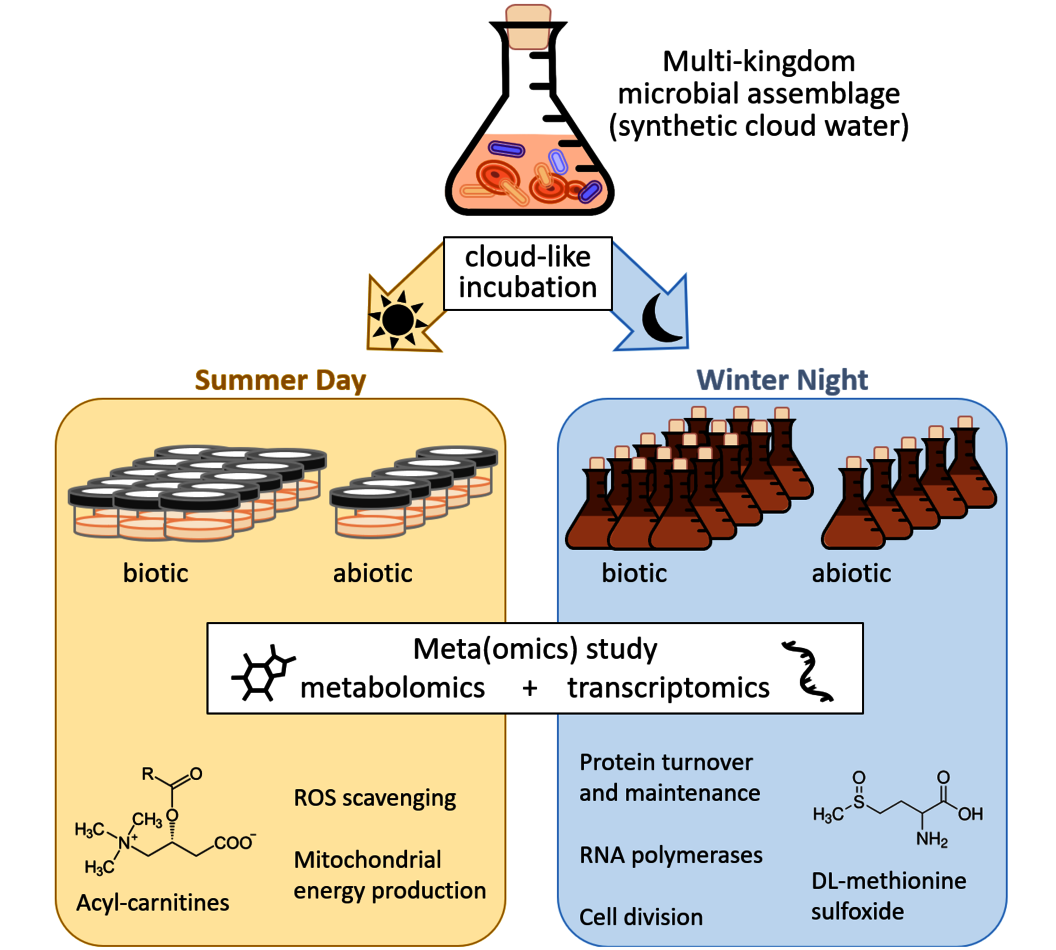
Microorganisms maintain metabolic activity in clouds, with recognized impacts on the chemistry of small organic compounds, radicals, and their precursors. However, how microbial activity is modulated by cloud environmental variables remains unknown. Here we explored the metabolic response of an assemblage of representative microbial isolates from cloud water, composed of a basidiomycetous yeast (Dioszegia hungarica) and three bacterial strains (Rhodococcus enclensis, Pseudomonas syringae , and Pseudomonas graminis), in synthetic cloud water exposed to contrasted conditions of temperature (5◦C vs 17◦C), light (dark vs artificial solar light) and oxidants (0 μM vs 250 μM H2 O2 ), to mimic typical cloud conditions during winter night and summer day. Metabolomics and metatranscriptomics allowed the identification of 25 differentially abundant metabolites and 218 differentially expressed genes (DEGs). Both summer day metabolomes and metatranscriptomes suggested active mitochondria-driven energy production, with fungal DEGs involved in fatty acids biosynthesis and succinate assimilation, and three differentially abundant acylcarnitines that support fatty acid transport into the mitochondrion for oxidative phosphorylation. In contrast, bacteria displayed DEGs for cell division arrest and components of reactive oxygen species scavenging systems. Under the winter night condition, both bacteria and yeast exhibited a similar prosperous state with DEGs encoding translation, protein repair and turnover, as well as cell cycle related functions. Thus, eukaryotes and prokaryotes may engage in distinct strategies to survive in clouds, depending on environmental conditions. This study consolidates our understanding of microbial roles and interactions in cloud water, paving the way for deeper insights into the chemistry of atmospheric systems.